Foundation Crack Repair: When to Worry and How to Fix It
Finding a crack in your foundation can be alarming, but not all cracks indicate serious problems. Understanding which cracks need immediate attention versus which are cosmetic can save you money and prevent unnecessary stress.
Professional foundation assessment determines crack severity and the appropriate repair method to protect your home's structural integrity. With proper diagnosis and repair, most foundation cracks can be effectively resolved.
Understanding Foundation Crack Types and Severity
Foundation cracks vary by size, direction, and location—each indicating different underlying causes and requiring specific repair approaches. Proper identification is crucial for effective treatment.
Horizontal Foundation Cracks
Horizontal cracks running parallel to the ground often indicate serious pressure from soil or water against foundation walls. These typically require immediate professional attention and may need structural reinforcement.
Causes: Hydrostatic pressure from saturated soil, poor drainage, or expansive soil conditions.
Severity: High priority—often indicates structural stress requiring immediate repair.
Repair Method: Carbon fiber reinforcement, wall anchors, or complete foundation replacement in severe cases.
Vertical Foundation Cracks
Vertical cracks running up and down are usually less serious and often result from normal concrete settling. However, wide vertical cracks (over 1/8 inch) should still be professionally evaluated.
Causes: Natural concrete settling, temperature changes, or minor foundation movement.
Severity: Low to medium priority—monitor for changes.
Repair Method: Epoxy or polyurethane injection for cracks wider than 1/16 inch.
Diagonal Foundation Cracks
Diagonal cracks at 30-75 degree angles often indicate foundation settling or uneven pressure. The direction and width help determine severity and required repairs.
Causes: Uneven settling, soil movement, or differential foundation loading.
Severity: Medium priority—requires professional assessment.
Repair Method: Underpinning, helical piers, or injection depending on cause.
Stair-Step Cracks in Block Foundations
These cracks follow mortar joints in block walls and can indicate significant foundation movement requiring professional assessment and repair.
Causes: Bowing walls, lateral pressure, or foundation settlement.
Severity: High priority—structural integrity compromised.
Repair Method: Wall anchors, carbon fiber reinforcement, or wall replacement.
Professional Foundation Crack Repair Methods
Epoxy Injection
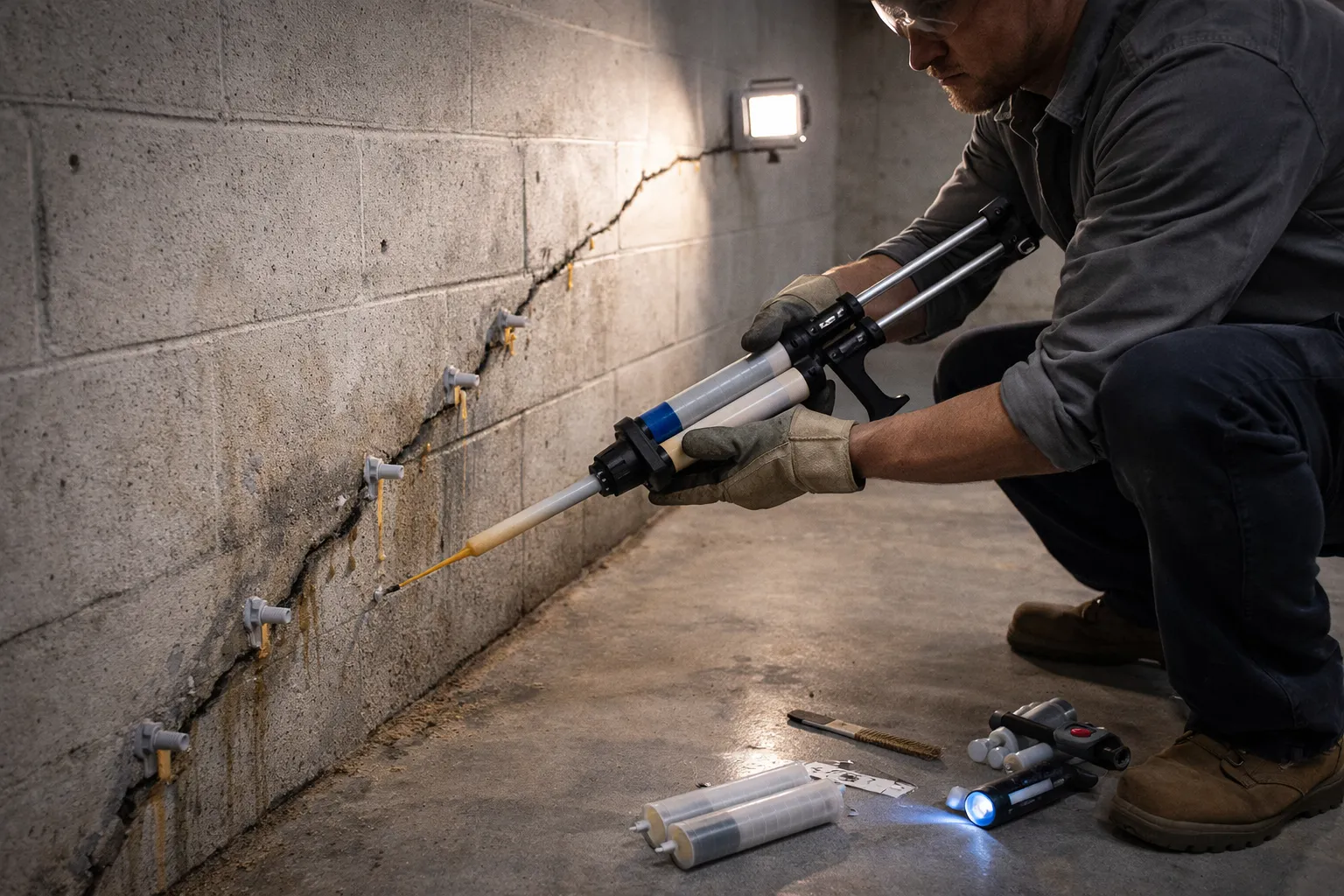
Epoxy injection fills cracks with structural-grade epoxy that bonds concrete together, restoring original strength. Best for non-moving cracks under 1/4 inch wide.
Process: Ports are installed along the crack, epoxy is injected under pressure, and cured for 24-48 hours.
Cost: $300-$800 per crack.
Effectiveness: 95% success rate for appropriate applications.
Polyurethane Injection
Polyurethane foam expands to fill cracks and can accommodate slight movement. Ideal for active water leaks and cracks that may shift with temperature changes.
Process: Similar to epoxy but uses expanding foam that seals against water intrusion.
Cost: $400-$1,000 per crack.
Effectiveness: Excellent for water-sealing applications.
Carbon Fiber Reinforcement
Carbon fiber straps or grids are applied to foundation walls to add tensile strength and prevent further cracking or bowing.
Process: Surface preparation, epoxy application, and carbon fiber placement.
Cost: $400-$1,200 per strap.
Effectiveness: Permanent structural reinforcement.
Helical Piers and Underpinning
For severe foundation issues, helical piers are driven to stable soil to lift and stabilize foundation sections.
Process: Excavation, pier installation, and foundation lifting.
Cost: $1,000-$3,000 per pier.
Effectiveness: Permanent solution for foundation settlement.
When to Call a Professional Foundation Expert
Immediate Action Required
- Cracks wider than 1/4 inch
- Horizontal cracks across foundation walls
- Multiple cracks in same area
- Cracks that are growing over time
- Water actively leaking through cracks
- Doors or windows sticking near cracks
- Floors sloping near crack locations
Monitor These Situations
- Hairline cracks (less than 1/16 inch)
- Vertical cracks from normal settling
- Cracks that haven't changed in 6+ months
- Cracks in non-structural areas
Foundation Crack Prevention Strategies
Proper Drainage Management
Maintain gutters, downspouts, and grading to prevent water from pooling around your foundation. Install French drains if necessary for proper water diversion.
Soil Moisture Control
Consistent soil moisture levels prevent expansion and contraction that stress foundations. Use soaker hoses during dry periods and proper drainage during wet periods.
Regular Inspections
Inspect foundation quarterly for new cracks or changes in existing cracks. Early detection prevents minor issues from becoming major problems.
Tree Root Management
Plant trees at least 20 feet from foundation and install root barriers if necessary. Large trees can cause foundation damage through root growth and moisture absorption.
Need Help With Your Basement?
If you're dealing with basement dampness or water damage, our local experts can help. Get a free, no-obligation assessment today.